
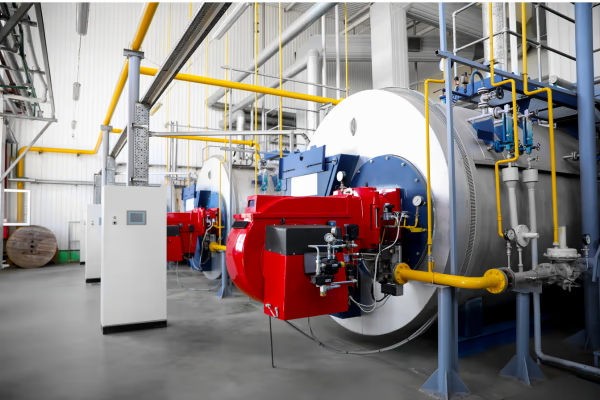
In commercial and industrial facilities, boilers supplying steam or hot water are major energy consumers. According to a technical discussion paper on boiler use in Australia and New Zealand, boilers account for around 25 % of natural gas use in industrial applications.
Therefore, improving boiler efficiency offers a meaningful opportunity to reduce fuel consumption, support cost control, and contribute to your site’s sustainability commitments.
Key factors that affect boiler efficiency
Several core elements determine how much of the fuel you input is converted into useful heat output:
- Combustion efficiency and air-to-fuel control: Effective combustion minimises unburned fuel and excess air. Industry guidance suggests that poorly controlled excess air can reduce boiler efficiency by around 5 %.
- Flue-gas and stack losses: Heat leaving the boiler via exhaust gases represents energy lost. One guide notes that most boilers may lose 15-20 % of fuel energy input through the stack under certain conditions.
- Feed-water quality, scale, and condensate management: Scale or deposits reduce heat-transfer efficiency. A report modelling industrial boilers observed efficiency dropping from about 91 % to 87 % over a five-day period when heat losses accumulated.
- Distribution and insulation losses: Even a well-performing boiler will lose efficiency if steam or hot-water piping is poorly insulated, or condensate return is minimal. The Australian government’s “Process heat and steam” equipment guide highlights insulation and maintenance of distribution systems as key improvement areas.
- System load matching and equipment age: Older boilers, or systems operating far below design load, generally convert fuel to heat with less efficiency. The Australian manufacturing gas-efficiency guide indicates that many manufacturing plants have untapped opportunities simply because equipment is beyond 15-20 years in operation.
Simple maintenance tips that improve performance and reduce fuel consumption
Even without major capital expenditure, routine maintenance and operational discipline provide measurable benefits:
- Burner tuning and air-fuel ratio monitoring: Checking and adjusting the burner to ensure minimal excess air and appropriate flame stability helps reduce fuel wastage. Industry material shows that a 5 °C rise in flue-gas temperature may indicate approximately a 1 % drop in boiler efficiency.
- Tube cleaning and scale removal: Regular cleaning of heat-exchange surfaces to remove soot and deposits helps restore heat transfer performance.
- Maximise condensate return and pre-heat feed-water: Returning hot condensate reduces the energy required to raise make-up water to temperature. The Australian manufacturing gas-efficiency guide stresses the importance of feed-water pre-heating and blow-down reduction.
- Inspect and repair insulation and steam/hot-water distribution systems: The government guide lists piping insulation, repair of steam traps and elimination of leaks as “quick wins” for energy improvements.
- Monitor operating parameters and track performance trends: Regular measurement of stack temperature, fuel consumption per unit output, load profiles, and steam system behaviour allows you to detect drift in efficiency and act before losses escalate.
How upgrades like economisers and burner controls make a difference
When your system is operating well, targeted upgrades may deliver further gains:
- Economisers / waste-heat recovery: These devices recover heat from flue gases to pre-heat feed-water, effectively reducing fuel input needed. A white-paper on boiler economisers suggests an average efficiency improvement in the range of 4-10 % when waste-heat recovery is applied.
- Advanced burner controls and oxygen trim: Automated combustion-control systems adjust air and fuel dynamically to maintain optimal efficiency even as load and fuel quality vary. That helps reduce excess-air losses and maintain efficient operation.
- High-efficiency boiler models and equipment upgrades: In Australia and New Zealand, some higher-efficiency boilers with enhanced designs (such as turbulators) report around 5 % improvement in thermal efficiency over standard units.
- System-wide optimisation: Upgrades deliver best results when applied across the boiler system—combustion, heat recovery, controls, feed-water and distribution—rather than as isolated fixes.
Real-world energy savings case examples for businesses
Although detailed public case-studies for every facility are limited, several insights provide useful benchmarks:
- The Australian manufacturing gas-efficiency guide notes that by implementing gas-efficiency and process-heat initiatives, manufacturing reliance on gas could fall by at least 25 %, which would correspond to estimated emissions savings of about 10 Mt CO₂-e per year.
- The “Boiler Efficiency – U3” fact sheet reports that with monitoring flue gas and addressing excess air, boiler efficiency improvements were achieved and that a 5 °C increase in flue-gas temperature corresponded to ~1 % efficiency loss.
While individual savings vary by fuel type, system size, operating hours and existing inefficiencies, these publicly available figures underline that measurable improvements are possible and quantifiable when systems are actively managed.
Environmental benefits of efficient boilers and reduced emissions
Improving boiler efficiency offers clear environmental benefits beyond cost savings:
- Lower fuel consumption means fewer greenhouse-gas (GHG) emissions per unit of steam or hot-water generated. This supports corporate sustainability goals and assists in meeting national emissions-reduction objectives.
- Reduced energy use also lowers demand on utilities, helping minimise upstream energy-losses and associated supply-chain impacts.
- Better-maintained, more efficient systems generally require less make-up water, fewer chemicals for feed-water treatment and produce less blow-down or waste, reducing resource consumption and environmental impact—an approach highlighted in the manufacturing gas-efficiency guide.
- Participating in recognised energy-efficiency programs or schemes may provide additional environmental and reputational benefits for your facility, especially where efficiencies align with funding eligibility or public-reporting frameworks.
Next Steps
Maximising your boiler or steam/hot-water system’s efficiency is a tangible way to reduce operating costs, enhance system reliability and support environmental goals. The process involves:
- Reviewing key performance factors such as combustion control, heat recovery, feed-water quality and distribution losses.
- Applying disciplined maintenance and operational best practices to capture “low-cost” efficiency gains.
- Exploring upgrades such as economisers, advanced controls and high-efficiency boilers when system condition and business case allow.
- Monitoring and benchmarking performance to track efficiency improvements and drive continuous improvement.
If you’d like to explore how this applies in your facility, we provide an engineering-led audit, a detailed upgrade roadmap and support for funding applications under recognised programs.
