Industrial Boiler Maintenance Checklist: Daily to Annual Tasks
An industrial boiler maintenance checklist is a schedule of inspection, testing and servicing tasks grouped by interval: daily, weekly, monthly, three-monthly and annual. Daily, a trained operator checks pressure and water level, blows down the gauge glass, tests the low-water device, checks alarms and leaks, and logs it all. Weekly and monthly, the team reviews trends, water treatment, blowdown, controls and safety valve test dates. Every three months the boiler water is tested. Every year a competent person inspects the boiler inside and out, tests the safety devices and certifies it safe to return to service.
Uptime is planned. Not lucky.
This checklist follows WorkSafe Victoria’s guidance on boiler inspection and maintenance and the Australian Standards it points to. The final intervals for your plant come from the boiler manufacturer, the boiler’s attendance category under AS 2593 and your state regulator. Use this as the frame. Confirm the detail for your site.
Why a boiler maintenance schedule matters
A boiler failure is rarely just a boiler problem. Steam stops. Production stops with it.
Most breakdowns give warning. O’Brien’s service teams trace most industrial boiler breakdowns to five causes: low water, flame failure, scale and water-side fouling, feedwater and water treatment faults, and control or sensor failures. Every one of them appears on a checklist before it appears as an outage.
There is a legal side as well. According to WorkSafe Victoria, employers have a duty to inspect boilers to an extent that monitors the risks of their use, with a competent person carrying out periodic internal and external inspections. Its example is scale: scale creates hot spots inside a boiler, and hot spots can lead to an explosion.
A structured schedule delivers four outcomes:
- Fewer unplanned outages, because faults are found on a planned visit instead of mid-production.
- Lower fuel use, because a clean water side and a tuned burner make the same steam on less gas. The boiler efficiency guide covers the numbers.
- Proven safety, because low-water protection, flame safeguards and safety valves are tested, not assumed.
- Compliance on record, because the logbook and service reports show an inspector the boiler is managed.
Daily operator checks
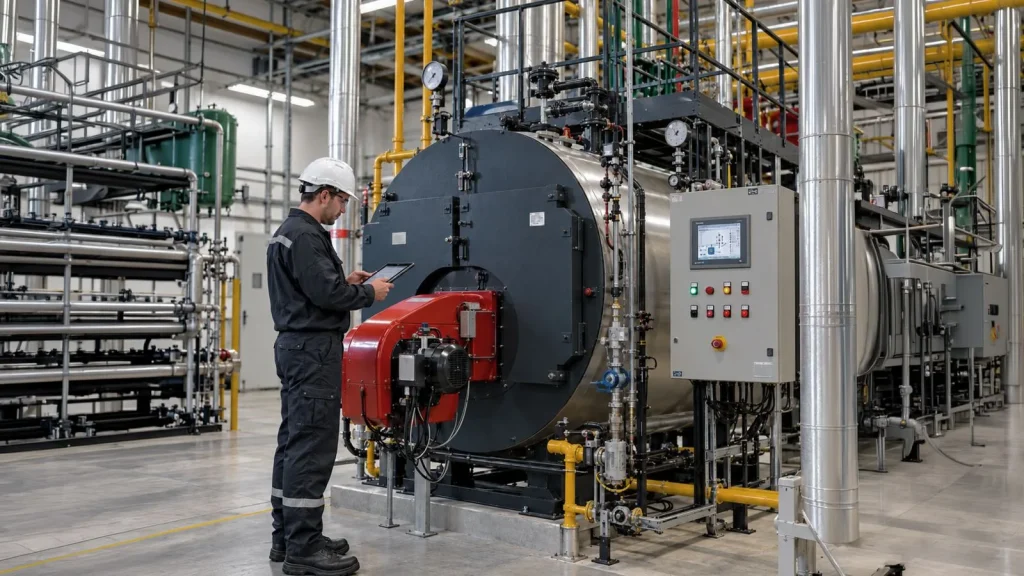
The daily section of a boiler maintenance checklist belongs to a trained operator, working to the site’s written procedure. They are observation and proof tests. Not repairs.
According to WorkSafe Victoria, the daily routine covers:
- A pre-operation check before start-up or shift handover.
- Blowdown of the water gauge glasses, which clears impurities that make the level reading wrong.
- A test of the water-level security equipment, such as the low-water device, to the site procedure.
- Boiler pressure and water level checked against the recommended range.
- Any steam leak reported and fixed straight away.
- Boiler blowdown as the water treatment company recommends, keeping chemicals in range and stopping scale.
- Hot surfaces and pipework insulated or guarded.
- Safety data sheets for boiler chemicals current and accessible, and the right PPE provided.
- No flammable materials stored near the boiler, and serviced fire extinguishers in place.
Add the plant-specific checks:
- Burner flame and firing pattern compared with normal.
- Active alarms, lockouts or warning lights on the control panel.
- New noise, knocking or vibration.
- Every reading, test and observation entered in the boiler logbook.
Never reset a lockout before the cause is known. A repeated reset on a low-water or flame-failure fault can turn a repair into a replacement.
Operators running these checks need the right licence and site training. O’Brien delivers boiler operator training as a Registered Training Organisation, RTO #45484.
Weekly and monthly checks
Weekly and monthly checks look for trends. One reading says little. Four weeks of readings show a boiler drifting.
Weekly
A weekly check compares the last seven days of logbook entries. It catches the slow faults a single shift misses.
- Review the logbook for drift in pressure, firing rate, water use or blowdown frequency.
- Check pipework, valves, flanges and gaskets for weeping, corrosion or deposits.
- Confirm alarms and indicators work as the site procedure requires.
- Check water treatment dosing and chemical stock.
- Close out last week’s defects, or escalate them.
Monthly
- Safety valves: confirm inspection and test dates are current with a competent person. Do not lift a safety valve as a routine check unless an approved procedure calls for it.
- Controls: review burner management, level controls and indicators for faults or nuisance trips.
- Feedwater: review the feedwater tank, pumps and treatment records.
- Blowdown: confirm the blowdown valves, and any automatic TDS control, work as the manufacturer specifies.
- Combustion: note changes in flame, flue temperature or fuel use that justify a technician visit.
- Records: list open defects, overdue tests and parts on order.
A slow change is the signal. Rising fuel use at the same load points to fouling or combustion drift. More frequent blowdown points to water treatment. Neither fixes itself.
Quarterly and annual servicing
Operator checks find problems. Servicing prevents them. Preventive boiler maintenance at these intervals is technician work.
Every three months
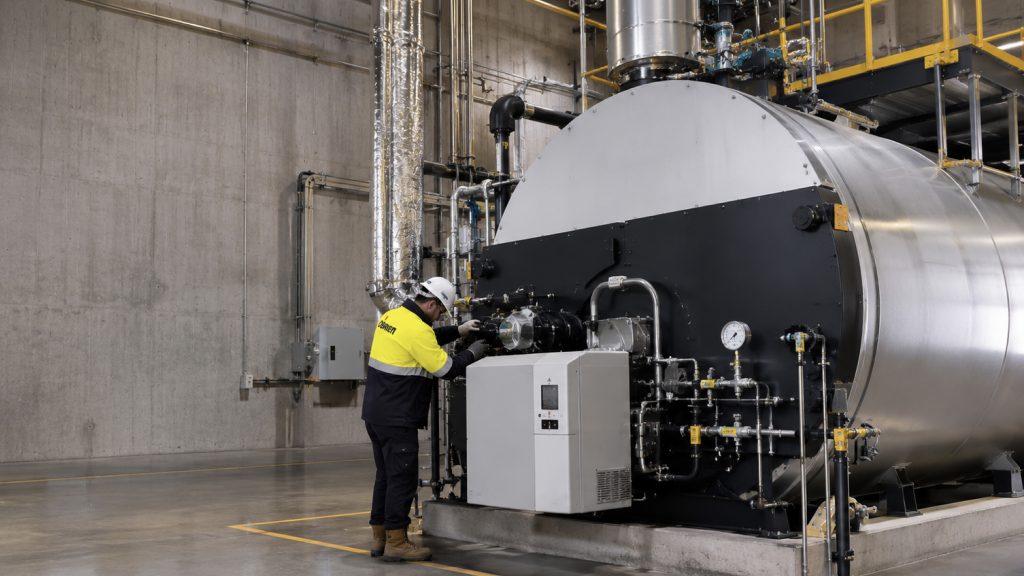
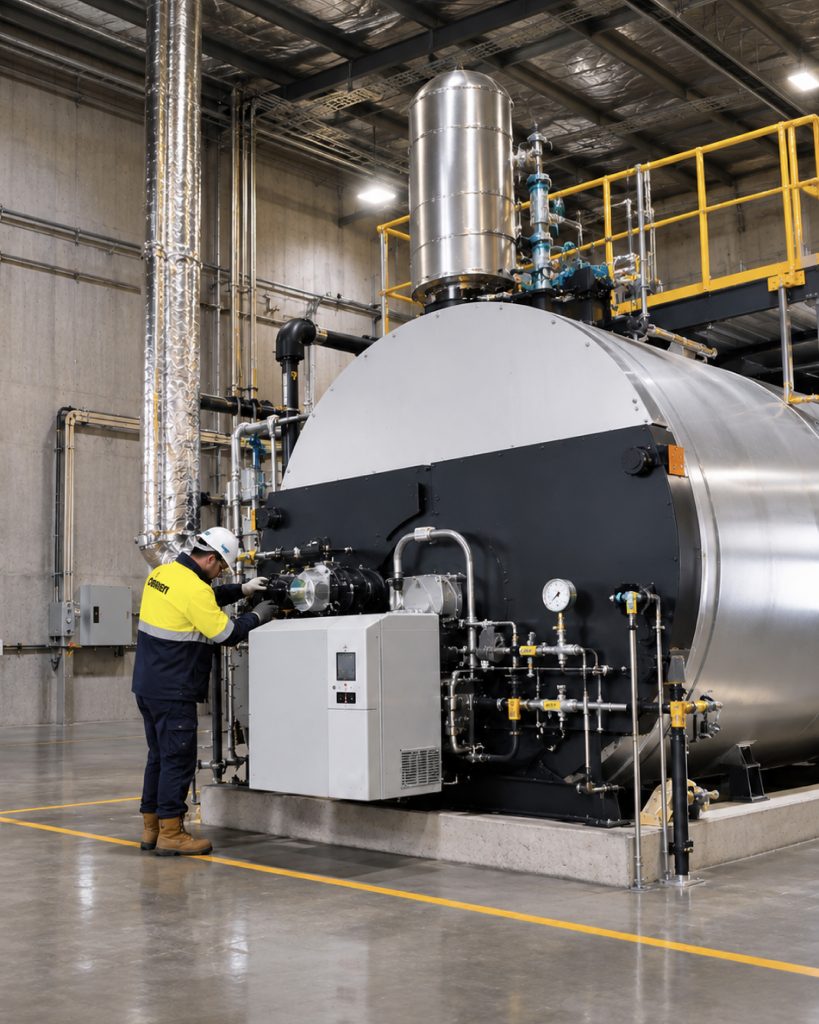
According to WorkSafe Victoria, an effective maintenance program includes three-monthly boiler water treatment and testing. Boilers on continuous duty are commonly serviced quarterly as well. At Lion’s Perth brewery, two 500 kW OBYONE firetube steam boilers, each rated at 800 kg/hr and certified for unattended operation, run on a three-monthly O’Brien service and hold 86% thermal and 88% combustion efficiency.
A quarterly service typically covers:
- Burner inspection and combustion tuning.
- Safety and control device testing.
- Water treatment testing, reviewed with the treatment provider.
- Accessible components, connections and gaskets inspected.
- Worn parts identified and ordered before they fail.
Combustion performance should be assessed by appropriately qualified technicians using suitable testing equipment. Where changes in flame behaviour, flue temperature or fuel consumption indicate a potential issue, O’Brien’s furnace and combustion services can support inspection, diagnosis and optimisation of industrial combustion systems.
Every year
The annual service is usually a planned shutdown. According to WorkSafe Victoria, employers should have a competent person carry out periodic internal and external inspections, with operational tests and the maintenance needed to keep the boiler safe and reliable.
The annual scope typically covers:
- Water-side and fire-side inspection, with the boiler opened and cleaned.
- Pressure parts assessed for corrosion, scale and soundness.
- Safety valves, low-water devices and flame safeguards tested.
- Combustion optimisation across the firing range.
- Controls, interlocks and alarms proven.
- A written report against Australian Standards.
Before the boiler returns to use after cleaning, inspection, servicing or repair, a certificate or report should state that it is safe to operate.
An annual service does not replace a statutory inspection or registration your state requires. In-service inspection of pressure equipment sits under AS/NZS 3788. Boilers certified for unattended operation carry their own checking and testing schedule under AS 2593, explained in the AS2593 unattended boiler guide.
The annual report is also where the life of the boiler gets judged. Recurring repairs, falling efficiency and parts that are hard to source start the repair or replace question. The boiler replacement cost guide sets out what that decision involves.
Operator checks vs technician maintenance
A boiler maintenance schedule is only as good as the names on it. Operators watch, test to procedure and record. Technicians inspect, test safety devices, tune and repair. Write the split into the site procedure and name who does each task.
Site operators, trained and licensed where required:
- Pre-operation checks and gauge glass blowdown.
- Low-water device tests to the site procedure.
- Pressure, water level and burner observation.
- Leak, noise and alarm checks.
- Blowdown as the water treatment provider directs.
- Logbook entries and defect reports.
Competent technicians:
- Internal and external inspections.
- Safety valve, low-water device and flame safeguard testing and service.
- Combustion tuning and optimisation.
- Control, interlock and burner management faults.
- Repairs, parts replacement and gasket work.
- Service reports and inspection certificates.
Operators never bypass a safety control to keep a boiler running. If a boiler shows signs of unsafe operation, the site shutdown and escalation procedure applies.
Warning signs that need immediate service
Some faults cannot wait for the next scheduled visit. For example:
- Repeated alarms, lockouts or trips.
- Pressure or water level that will not hold steady.
- Steam or water leaks.
- New noise, knocking or vibration.
- A flame that looks or sounds different.
- Fuel use rising with no change in load.
- Water treatment results out of range.
- Corrosion or deposits on accessible parts.
When a boiler fails, work in this order. Isolate the unit to the manufacturer’s procedure and lock out fuel and power. Record the alarm or lockout code, the water level and the pressure at the moment of failure. Protect production with a standby unit, by shedding non-critical steam load, or with a temporary hire boiler. Then call a qualified boiler technician.
O’Brien runs a 24/7, 365-day nationwide breakdown response, with boiler parts on hand and custom gaskets manufactured in-house. Common failures do not wait on a supplier.
Record-keeping for compliance
Records are the proof. Without them, a well-run boiler and a neglected one look the same to an inspector.
According to WorkSafe Victoria, employers in Victoria must keep inspection and maintenance records for boilers rated hazard level A, B or C under AS 4343, for as long as they manage or control the plant. Other states set their own rules; your state regulator confirms them.
Keep these in the boiler file:
- Daily logbook readings and test results.
- Water treatment results.
- Service reports and inspection certificates.
- Safety valve and safety device test records.
- Defects, corrective actions and parts replaced.
- Operator training and licence records.
- Open items and recommended follow-up.
Under AS 2593, these records are what show the supervision system works: logs, test results, maintenance records, alarm history and training records. A full file also makes the next decision easier, whether that is a repair, an upgrade or a replacement.
Frequently asked questions
How often should an industrial boiler be serviced?
There is no single national interval. It depends on duty, fuel, the manufacturer, insurer requirements and the boiler’s attendance category under AS 2593. Boilers on continuous duty are commonly serviced quarterly, with a full annual inspection and shutdown. O’Brien sets the boiler servicing schedule in a service agreement, from one preventative visit a year on the Essential plan, to two on Performance, to quarterly on Premium.
Who should perform industrial boiler maintenance?
Industrial boiler maintenance is split between two roles. Trained operators, licensed where the boiler requires it, carry out the daily and weekly checks to the site procedure. A competent boiler technician carries out the internal and external inspections, safety valve and low-water device testing, combustion tuning and repairs. The site procedure names who does each task.
What is AS 2593?
AS 2593:2021 is the Australian Standard for boiler safety management and supervision systems. It sets the controls, alarms, interlocks, checking, testing, maintenance and operator competency a boiler needs for its attended or unattended mode. In-service inspection of the pressure parts sits under AS/NZS 3788. The current edition is listed at Standards Australia.
What happens if a boiler is not maintained?
Scale builds on the water side and creates hot spots, which WorkSafe Victoria warns can lead to an explosion. Fuel use rises as heat transfer falls. Safety devices that are never tested may not work when they are needed. Output falls too: the 6 MW boiler at Real Pet Food in Yatala was producing 4,800 kg/hr against a rated 9,100 kg/hr until O’Brien restored it, after which Real Pet Food reported a 28.5% reduction in gas use and an estimated saving of about $45,000 a month.
What should a daily boiler checklist include?
A daily boiler checklist is the operator’s routine for every shift the boiler runs. Following WorkSafe Victoria’s guidance, it covers a pre-operation check, gauge glass blowdown, a low-water device test, pressure and water level against the recommended range, alarms and lockouts, leaks, burner flame, blowdown as the water treatment provider directs, and a logbook entry for every reading and test.
Does O’Brien provide emergency boiler breakdown support?
Yes. O’Brien provides a 24/7, 365-day nationwide breakdown response, with parts on hand and gaskets manufactured in-house. Attendance times depend on site location and access, and are confirmed on the call.
Put a maintenance plan in place with O’Brien
20+ years. 40,000+ jobs completed. 350+ years of combined team experience. O’Brien is Australia’s largest privately owned boiler company.
Use this boiler maintenance checklist as the site routine. O’Brien builds boiler service and maintenance around your plant: the right interval, the right scope, and records that stand up to an inspector. Planned visits replace emergency calls. Downtime becomes predictable.
Talk to the O’Brien service team to put a maintenance plan in place.