Commercial and Industrial Heat Pumps: How They Work and When They Beat a Boiler
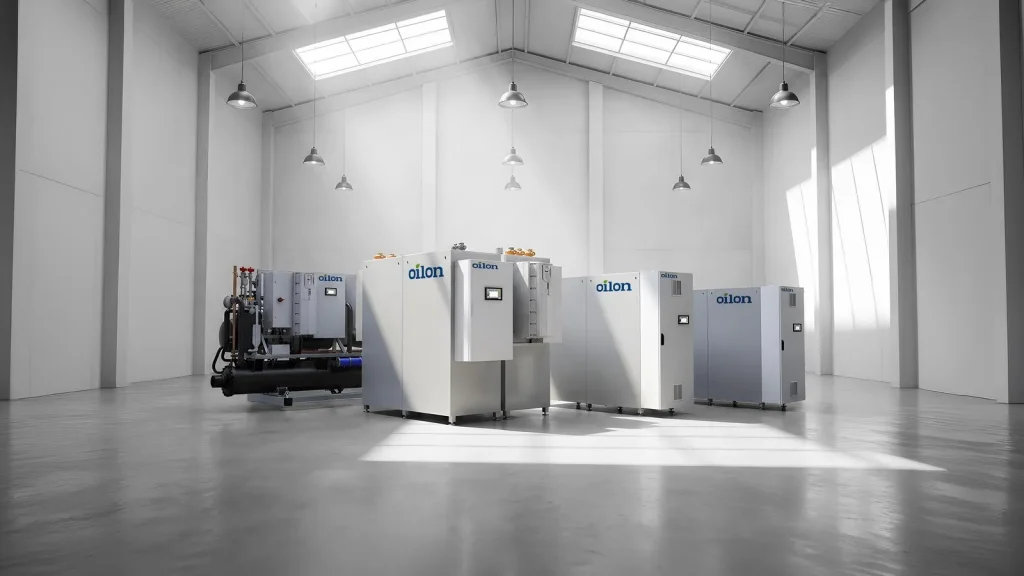
A commercial heat pump is an electrically driven unit that makes hot water by moving heat instead of burning fuel. A compressor lifts low-grade heat from outdoor air, a cooling circuit or warm wastewater to the temperature a building or process needs, so one unit of electricity delivers several units of heat. According to the International Energy Agency (IEA), heat pumps on the market in 2022 were three to five times more energy efficient than natural gas boilers.
An industrial heat pump works the same way at a larger scale and a higher temperature. On Australian process sites, an industrial heat pump usually takes over the hot water duties first: washdown, clean-in-place (CIP), process water and feedwater preheating. The boiler stays for steam and peak loads.
O’Brien Energy supplies both classes in Australia. The OBYLN air source commercial heat pump delivers hot water to 75 °C. Oilon ChillHeat industrial heat pumps reach 120 °C on the P Series.
How a commercial heat pump works
A heat pump is a refrigeration circuit run for its hot side. Refrigerant circulates in a sealed loop and never mixes with the process water or the product. The cycle has four stages.
Evaporation. Cold, low-pressure refrigerant absorbs heat from the source and boils. The source can be outdoor air, a refrigeration condenser loop, process cooling water or wastewater.
Compression. An electric compressor raises the refrigerant’s pressure and temperature. This is the only stage that draws significant power.
Condensation. The hot refrigerant releases its heat into the hot water circuit through a heat exchanger.
Expansion. A valve drops the pressure and the loop starts again.
Heat delivered equals heat collected at the source plus the compressor’s input. That is why output exceeds electricity use. A boiler can only release the energy in the fuel it burns, less flue and shell losses.
Commercial vs industrial heat pumps
Most commercial heat pumps sold in Australia are air source hot water units for hotels, offices, schools, gyms and shopping centres. Industrial heat pumps are selected around production: higher temperatures, a recovered heat source and long running hours.
Air source commercial heat pumps take heat from outdoor air, so they need no waste heat source. That makes them the simplest switch from gas hot water.
Water source industrial heat pumps take heat from a stream already on site: refrigeration plant, wastewater, process cooling or flue gas. A warmer source means a smaller lift, a better COP and a higher reachable temperature.
Heat recovery heat pumps do two jobs at once. The cold side chills a process load while the hot side heats water. Where a site pays to cool product and pays again to heat washdown water, one machine serves both duties. This is where heat pumps reach their best efficiency.
Heat pump COP and temperature lift
Coefficient of performance (COP) is useful heat delivered divided by electricity consumed, over the same period and system boundary. A COP of 3.5 means 3.5 kWh of heat per 1 kWh of power. It is a figure at stated conditions, not an annual guarantee.
Temperature lift drives it. The gap between source and delivery temperature is the biggest single factor, and the refrigerant must also overcome the temperature difference across each heat exchanger. Every unnecessary degree costs efficiency. Challenge the specification before sizing: a washdown duty specified at 85 °C that actually runs at 65 °C is an avoidable penalty.
Compare like with like. A compressor-only COP excludes pumps, fans, controls and defrost; a whole-system COP includes them. Ask suppliers for both, at the same source and delivery temperatures.
How hot can an industrial heat pump get?
The temperature ceiling of an industrial heat pump is set by its refrigerant and its compressor. According to the IEA’s 2022 heat pump report, large heat pumps can provide heat up to 140 to 160 °C today, while the most common industrial units supply lower temperature heat.
For the ranges O’Brien supplies, the OBYLN delivers hot water up to 75 °C. The ChillHeat S Series delivers 85 °C, or 90 °C on the B-suffix models. The ChillHeat P Series reaches 120 °C with refrigerant R1233zd(E), safety class A1 with a GWP of 3.88; other refrigerants cap it lower, from 95 °C down to 80 °C.
These are hot water temperatures. None of the brochures lists steam output, so a process that needs steam at the load still needs a steam source. Our guide to steam vs hot water boilers sets out which duties genuinely need steam.
Many do not. The Australian Renewable Energy Agency (ARENA) notes that low temperature process heat around 80 °C, such as hot water, is among the most accessible to supply with renewable energy. Washdown, CIP, bottle washing and feedwater preheat usually sit there.
Heat pump vs boiler: when does a heat pump win?
A heat pump beats a fuel-fired boiler on running cost when four conditions hold together: a reliable heat source, a manageable temperature lift, enough operating hours, and an electricity price that stays competitive with gas once COP and real boiler efficiency are applied.
The first-pass comparison is cost per unit of useful heat: electricity price divided by seasonal COP, against fuel price divided by boiler efficiency. A worked example with illustrative prices, not quotes: at 25 c/kWh and a COP of 3.5, heat costs about 7.1 c/kWh. Gas at $20/GJ (7.2 c/kWh) through a boiler at 85% efficiency costs about 8.5 c/kWh. Change a price or the boiler’s real efficiency and the answer moves, so use your own tariffs and a measured efficiency. Our guide to improving boiler efficiency covers how to measure it.
A full business case then adds demand charges, any electrical upgrade, installation, storage, maintenance and the value of any cooling delivered. Site conditions point in clear directions:
Steady waste heat and steady hot water demand. Assess a heat pump first.
Hot water plus steam duties. Plan a hybrid: heat pump on the hot water base load, boiler on steam, peaks and backup.
Expensive electricity relative to gas. Model it carefully. A strong COP does not guarantee lower running cost.
An intermittent heat source. Add thermal storage so supply and demand line up.
ARENA’s funded project at Hardwick Processors in Kyneton, Victoria, shows the hybrid logic. ARENA announced $838,000 for a 1 MW (thermal) heat pump and an electrical supply upgrade at the meat plant, aimed at cutting its reliance on natural gas by over 75%. The feasibility study found it most efficient to run a smaller, less expensive heat pump continuously, storing hot water in existing thermal storage tanks.
Where heat pumps fit alongside boilers
On most process sites, the question is which duties move, not whether the boiler goes.
Separate hot water supply. Move washdown, CIP and process water off steam onto a heat pump loop.
Feedwater preheat. Raise boiler feedwater temperature so the boiler burns less fuel per kilogram of steam.
Simultaneous heating and cooling. Recover refrigeration or process cooling heat as hot water and unload the chillers at the same time.
Redundancy. ChillHeat units connect in series or parallel, and the P220 to P450 models carry two independent refrigerant circuits.
Check direct heat exchange first. If a stream is already hot enough to heat another through a plate heat exchanger, a heat pump adds cost for no gain. And keep the technologies apart: waste heat recovery boilers raise steam from hot exhaust, and electric boilers such as OBYPHASE convert power directly to heat with no source required. A heat pump upgrades a lower-temperature source.
The heat pump ranges O’Brien supplies
Full specifications are on the heat pumps page.
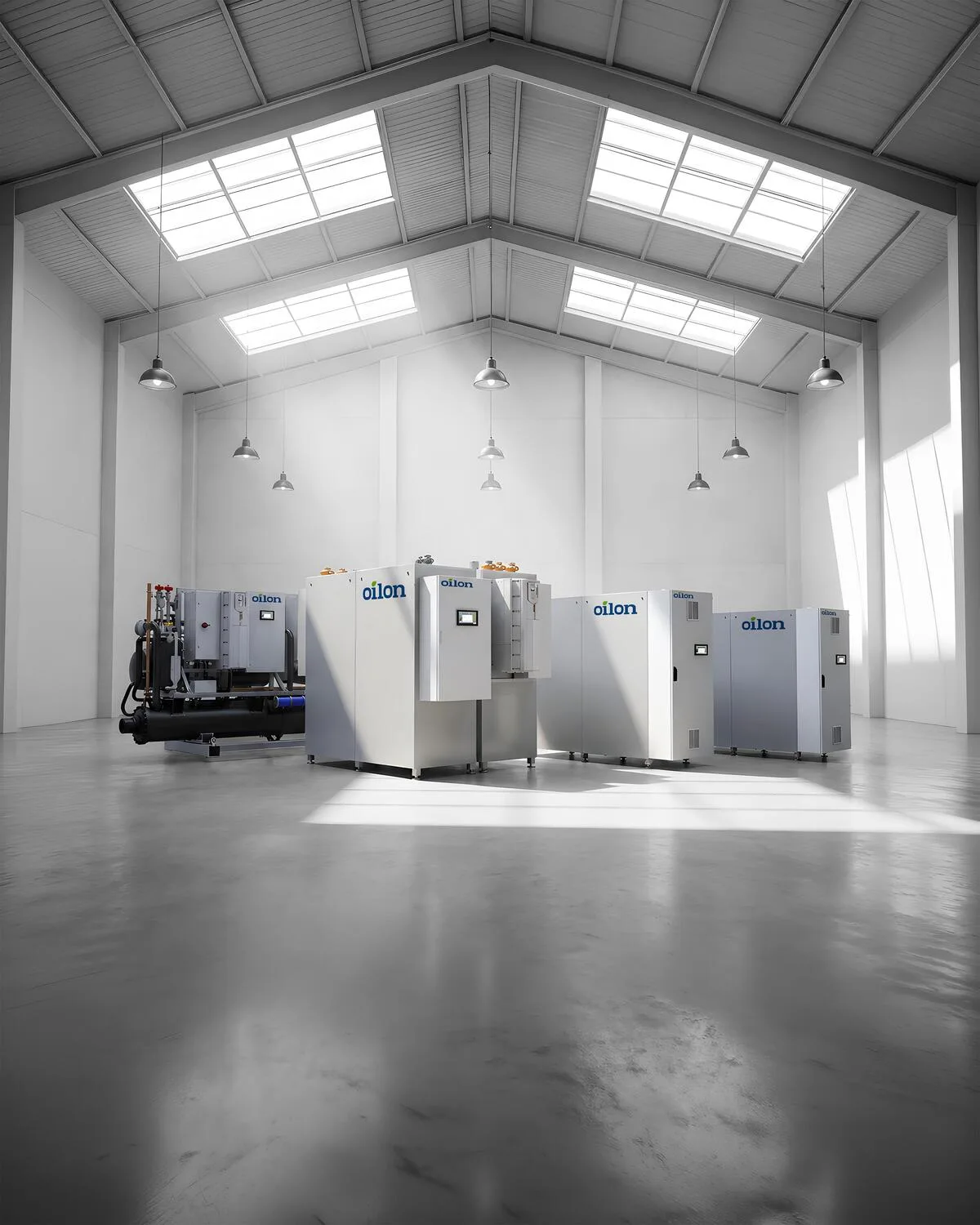
OBYLN air source commercial heat pump. BLN-050TC3 (50 kW) and BLN-075TC3 (75 kW). Hot water to 75 °C, operation down to −25 °C ambient with enhanced vapour injection, R290 refrigerant at GWP 3, up to 16 units in parallel. See the OBYLN brochure.
Oilon ChillHeat P Series, piston compressor. Nine models, P30 to P450, 30 to 450 kW per unit. Up to 120 °C. Rated excellent for combined heating and cooling. See the P Series brochure.
Oilon ChillHeat S Series, screw compressor. Eleven models, S180 to S2000, 180 to 2,000 kW per unit. 85 °C standard, 90 °C on S600B to S1000B. Single screw to S580, twin screw from S600. Rated excellent for water chilling and refrigeration heat recovery. See the S Series brochure.
Choose by the hottest duty first, then by size. O’Brien’s engineers confirm the final selection with Oilon’s Selection Tool.
Case study: Calfors Bruk, Sweden. Calfors Bruk runs Oilon ChillHeat heat pumps at high process temperatures and reported saving around 600,000 SEK in the first year. Read the Calfors Bruk case study. One plant’s result is not a forecast for another.
Heat pump decarbonisation depends on the whole system
A heat pump burns no fuel on site. Its emissions sit in the electricity it draws and the refrigerant it holds. The IEA found heat pumps reduce greenhouse gas emissions by at least 20% compared with a gas boiler, even on emissions-intensive electricity, and by as much as 80% where electricity is cleaner. Use your state’s grid emissions factor when you compare.
Refrigerant choice matters too. Options across O’Brien’s ranges run from GWP 1.37 (R1234ze(E)) to 1,430 (R134a). Low-GWP still needs proper safety design: R1234ze(E) is class A2L, mildly flammable, and Oilon offers a ventilated enclosure with gas detection for it.
Work in order: cut demand, recover heat directly, then electrify what is left. Our efficiency and decarbonisation team works that way, and the engineering and energy audit team maps your heating and cooling duties by temperature before anything is sized.
Frequently asked questions
What is a commercial heat pump?
A commercial heat pump is an electrically driven unit that moves heat from outdoor air, water or a process stream into a hot water or heating circuit for a commercial building or site. Typical users are hotels, offices, schools, gyms, shopping centres and food and beverage sites. The compressor adds a fraction of the delivered energy and the source supplies the rest, which is why output exceeds electricity use. According to the IEA, heat pumps on the market in 2022 were three to five times more energy efficient than natural gas boilers.
For example, the OBYLN range O’Brien Energy supplies comes in two sizes:
- BLN-050TC3, rated at 50 kW.
- BLN-075TC3, rated at 75 kW.
Both models deliver hot water up to 75 °C, keep running down to −25 °C ambient and use R290 refrigerant with a GWP of 3. Up to 16 OBYLN units connect in parallel for larger commercial hot water loads.
Can a heat pump replace a boiler?
The short answer is yes for hot water and no for steam. A heat pump can replace a boiler for hot water duties inside its temperature range, and that range now reaches 120 °C on the Oilon ChillHeat P Series with R1233zd(E) refrigerant. A heat pump cannot replace a boiler where the process needs steam at the load, for direct steam injection, sterilisation or steam-heated equipment.
In practice, most Australian process sites split the duties:
- Move washdown, CIP and process hot water onto the heat pump.
- Preheat boiler feedwater with recovered heat.
- Keep the boiler for steam, peak demand and backup.
ARENA describes low temperature process heat around 80 °C, such as hot water, as among the most accessible industrial heat to supply with renewable energy. The Hardwick Processors heat pump project in Kyneton, Victoria, was funded on that basis, with the aim of cutting the plant’s reliance on natural gas by over 75%.
How efficient is an industrial heat pump?
Industrial heat pump efficiency is measured as COP, the useful heat delivered divided by the electricity consumed over the same period. A COP of 3.5 means 3.5 kWh of heat for every 1 kWh of power. According to the IEA, heat pumps on the market in 2022 were three to five times more energy efficient than natural gas boilers.
Two factors decide the result on a real site:
- Temperature lift. A warmer source and a lower delivery temperature give a higher COP.
- Use of the cooling side. A heat recovery machine that also chills a process load earns credit for both outputs.
For example, Oilon reports a total system COP of 6.5 at the Ahascragh Distillery in Ireland, a 115 °C installation running two ChillHeat P450 units and one P150, as listed on O’Brien’s Oilon ChillHeat page. That figure counts heating and cooling together, so a heating-only machine on the same lift would read lower.
What is the best heat source for an industrial heat pump?
The best heat source for an industrial heat pump is warm, steady and available at the same hours as the hot water demand. Good heat recovery sources fall into four types:
- Refrigeration plant condensers.
- Wastewater.
- Flue gas.
- Industrial process streams.
Refrigeration condensers and process cooling water are the usual first choice on Australian food and beverage sites, because the heat is already paid for in compressor electricity and is otherwise rejected to atmosphere. A warmer source means a smaller temperature lift and a higher COP. Outdoor air suits sites with no recoverable process heat, and the OBYLN air source heat pump covers that case down to −25 °C ambient. Where a source runs intermittently, thermal storage lets a smaller heat pump run for longer hours, which was the design ARENA funded at Hardwick Processors in 2022.
What does an industrial heat pump cost to run?
The running cost of an industrial heat pump equals the electricity price divided by the seasonal COP. For example, at an illustrative 25 c/kWh and a seasonal COP of 3.5, heat costs about 7.1 c/kWh. A gas boiler at an illustrative $20/GJ (7.2 c/kWh) and 85% efficiency delivers heat at about 8.5 c/kWh. These prices are illustrations, not quotes.
A full running cost picture adds three items the simple ratio leaves out:
- Electricity demand charges on the site tariff.
- Pumps, fans, controls and defrost energy outside the compressor.
- Maintenance on the heat pump and on any boiler that stays.
Installed cost depends on loads, temperatures, any switchboard or network upgrade, and how much existing pipework can be reused. O’Brien Energy’s site assessment produces a payback figure from the site’s own tariffs and measured boiler efficiency before any commitment.
What maintenance does an industrial heat pump need?
Industrial heat pump maintenance is a planned programme, not a once-a-year visit. A ChillHeat user at Francks Kylindustri, quoted in Oilon’s brochure, describes the units as designed for easy maintenance. A sound programme still covers five areas:
- Refrigerant charge and leak detection, especially on A2L refrigerants such as R1234ze(E).
- Compressor condition and oil.
- Heat exchanger fouling on both the source and sink sides.
- Water treatment on the hot water circuit.
- Controls, sensors and variable frequency drives.
Remote monitoring through Oilon Global Monitor lets engineers watch the system in the cloud and troubleshoot before a fault stops production. Oilon ChillHeat units ship with Modbus RTU as standard, so heat pump data can also feed the site’s existing control system. O’Brien Energy services the heat pumps it supplies from branches in Sunshine West (VIC), Prestons (NSW), Heathwood (QLD) and Malaga (WA), alongside the boiler plant on the same site.
Choose the system that fits the duty
Heat pumps earn their place wherever useful low-grade heat sits next to a steady hot water demand. On most process sites, the strongest result is a heat pump and a boiler working together, each on the duty it does best.
Explore O’Brien’s commercial and industrial heat pumps or book a free site assessment. Bring your temperatures, operating schedules and heat source data, or call 1300 771 759.