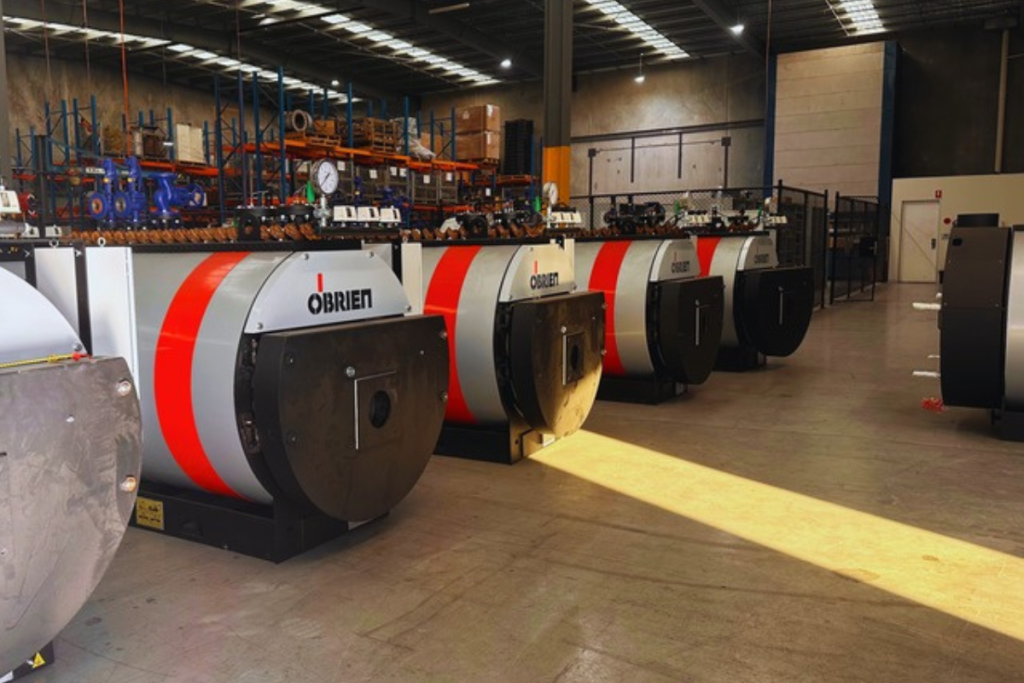
Steam Boiler vs Hot Water Boiler: Which Suits Your Process?
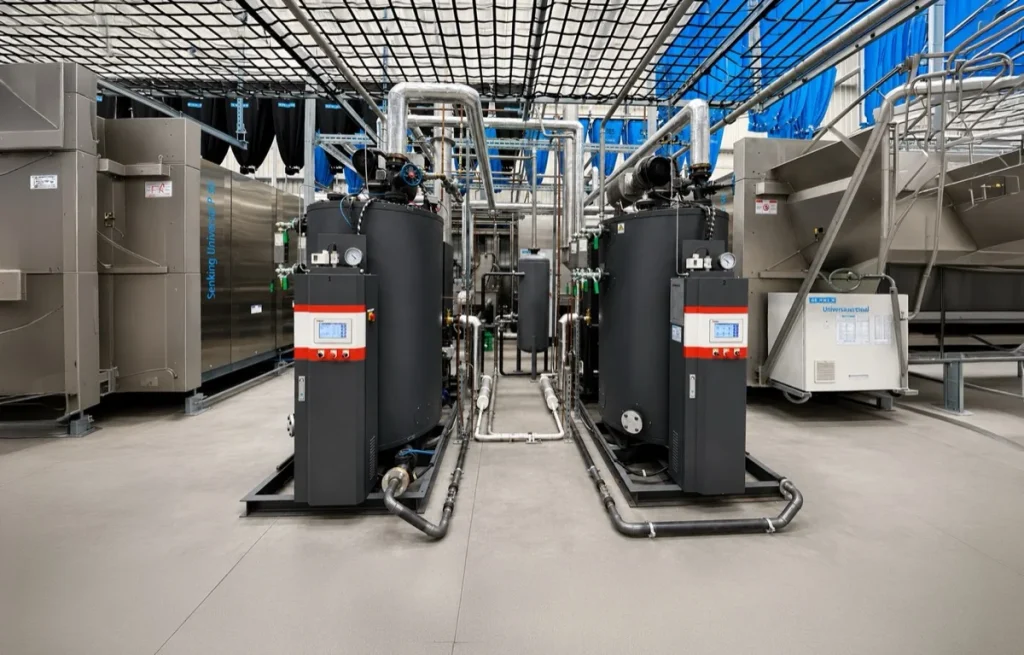
A steam boiler is a pressure vessel that boils feedwater and delivers heat as latent heat of vaporisation. Temperature at the load is fixed by the distribution pressure. A hot water boiler is a pressure vessel that heats water without a phase change and delivers sensible heat. Temperature is set by the supply and return design instead.
The steam boiler vs hot water boiler decision comes down to one question. Does the process need the medium, or only the heat. Specify steam where the process needs contact with the medium, sterilisation, or a fixed temperature above 120°C at the load. Steam carries roughly 24 times more energy per kilogram than circulating hot water. Specify hot water where the process needs controllable temperature below 120°C and heat transfers indirectly through coils or heat exchangers. O’Brien manufactures and supplies both, across industrial and commercial boilers for Australian plant.
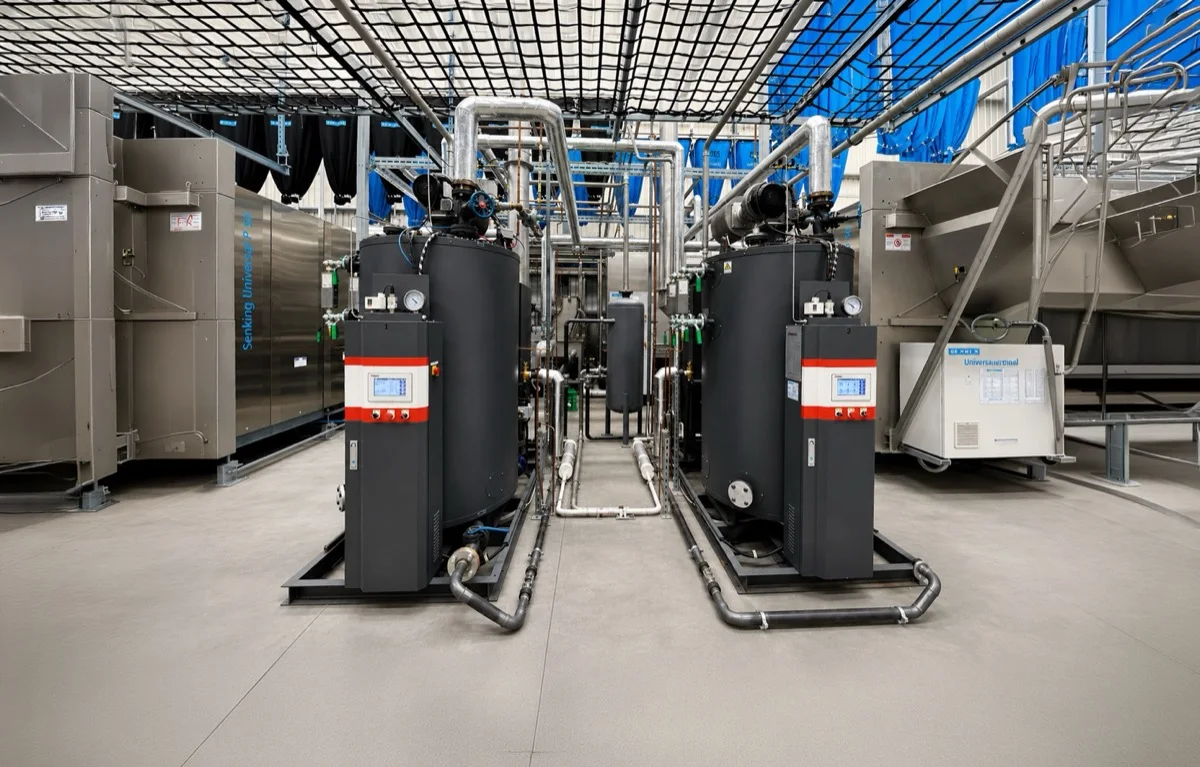
Steam boiler vs hot water boiler: the short answer
Three things separate the two systems, and each one carries a number.
Energy form is the first. Steam carries latent heat. At 10 bar gauge, saturated steam releases roughly 2,000 kJ for every kilogram that condenses at the load. Hot water carries sensible heat only, and one kilogram of water crossing a 20 K temperature difference releases about 84 kJ. Steam therefore moves roughly 24 times more energy per kilogram of medium.
Temperature control is the second. Steam temperature follows saturation pressure and cannot be set independently of pressure. Hot water temperature is a design choice, trimmed at a mixing valve to whatever the process needs.
Plant obligation is the third. Steam plant brings condensate return, trap stations, water treatment and, in Australia, boiler attendance and supervision duties under AS 2593. Hot water plant brings pumps, expansion volume and heat exchanger surface instead. Get the utility interface at the load right and the rest of the specification follows.
Why steam and hot water are not interchangeable
The 24:1 energy ratio is worth restating in flow terms, because the ratio drives every downstream difference in a steam vs hot water boiler comparison for process heating.
Delivering 1 MW of process heat with saturated steam at 10 bar gauge means moving about 1,800 kg/h of steam. Delivering the same 1 MW through a hot water loop on a 20 K temperature difference means circulating roughly 43,000 kg/h of water, near enough to 43 m³/h. Same duty, 24 times the mass flow.
Steam mains are consequently small and need no pumping energy in the flow direction, because pressure does the work. Hot water mains are large and need continuous pump power, but carry no phase change, no flash steam, no trap population and no water hammer risk.
The ratio also explains turndown behaviour. A steam system holds a pressure setpoint, so distribution losses stay roughly constant as load falls. A hot water system drops flow and temperature together, which is why variable speed pumping delivers real part load savings on hydronic plant and very little on steam.
Temperature and pressure: what each system can reach
Steam: temperature follows pressure
In saturated steam service, temperature is not a free variable. Set the pressure and the temperature is decided. Indicative steam table values: at 1 bar gauge, saturated steam sits at 120°C carrying about 2,200 kJ/kg of latent heat. At 3 bar gauge, 144°C and 2,133 kJ/kg. At 5 bar gauge, 159°C and 2,085 kJ/kg. At 10 bar gauge, 184°C and 2,000 kJ/kg. At 12 bar gauge, 192°C and 1,974 kJ/kg.
Two consequences follow. Raising pressure to reach a higher process temperature costs latent heat per kilogram, so mass flow rises faster than the temperature gain suggests. And a pressure change ripples through the whole system, moving control valve sizing, pressure reducing station design and trap selection together.
Where a process needs more than saturated steam can give, superheat is the answer. The O’Brien watertube D type range within our watertube boilers can be configured to 565°C superheated steam, using convection or radiant superheater designs.
Hot water: temperature is a design choice inside a pressure limit
A hot water system avoids boiling by holding the loop above the saturation pressure of the hottest point in the circuit. Temperature is then a design decision rather than a consequence of pressure.
Three bands cover most industrial work. Low temperature hot water runs to about 95°C and suits space heating, wash systems and tank temperature maintenance. Medium temperature runs 100°C to 120°C and covers most indirect process duty. High temperature runs above 120°C and starts to compete with low pressure steam, at the cost of higher system pressure and tighter material selection.
The first two bands are where most hot water plant sits, and they are covered by one product family. The O’Brien OBYFLAME range within our commercial hot water boilers is a reverse flame firetube design rated 70 to 3,500 kW for system water between 60°C and 100°C, which takes in space heating, wash systems, tank temperature maintenance and the bulk of indirect process duty. Above 100°C the specification moves into higher system pressure and tighter material selection rather than simply turning the setpoint up.
The ceiling itself is set by the boiler pressure rating, and the real working limit sits below it. Gasket and seal materials, pump net positive suction head and the margin against nucleate boiling at local hot spots all bite before the nameplate does.
Distribution: what the pipework has to carry
A steam system is a two phase system whether the design admits it or not. Steam condenses in every metre of main, so the design must remove condensate continuously: drip legs at low points and ahead of risers, correctly sized traps, separators where dryness matters, and a condensate return network.
Steam quality is the variable most often missed. Wet steam cuts the heat transfer coefficient at the load, erodes valve seats and instrument internals, and raises water hammer risk. Drum internals, correct pipe gradient, adequate line sizing and point of use separators hold the dryness fraction up. The reverse flame, wet bottom firetube design in the O’Brien OBYONE range is built around exactly this, with a large evaporation area keeping water droplets out of the steam offtake under sudden load. OBYONE is the entry point on the steam side: 300 to 6,000 kg/h at up to 12 bar standard and higher on request, on liquid or gaseous fuel, which is roughly 170 kW to 3.3 MW of process heat at 10 bar gauge.
Capacity changes the scale of that problem, not its shape. OBYTRICE is the step up from OBYONE and keeps the same wet bottom firetube arrangement in a three pass monobloc package, running 2,000 to 22,000 kg/h at up to 12 bar standard, holding 90% thermal efficiency and up to 96% on special versions. A site moving from one to the other is buying more evaporation, not a different set of distribution problems: the drip legs, traps, separators and condensate return above scale with the duty rather than getting designed out of it.
A hot water system is single phase, which removes an entire category of failure. No traps. No flash steam at vents. No condensate to return, treat or lose. Hydraulic scope replaces the steam scope: pumps and variable speed drives, expansion and pressurisation, air and dirt separation, and control valves with real authority. Long distribution runs favour hot water, because heat loss per unit of energy delivered is lower.
Which process suits which
When a steam boiler is the right call
A steam boiler is the right call when the process needs the medium itself, or needs the temperature that only saturated steam delivers conveniently.
Direct injection, where steam enters the product or the vessel. Sterilisation and sanitation, including clean in place and steam in place duty, autoclaves and retorts. High heat flux in compact surface, because condensing steam has a far higher heat transfer coefficient than circulating water, which keeps jackets and coils small. Humidification. Driving steam equipment such as ejectors or absorption plant. And utility grade supply where several unrelated users share one generation plant through pressure reducing stations.
Food and beverage sites are the clearest example. Cookers, retorts, tunnel pasteurisers, kettles and clean in place skids all want steam. So do reactor jackets and distillation reboilers in chemical work.
When a hot water boiler is the right call
A hot water boiler is the right call when the temperature is moderate, the transfer is indirect, and control matters more than heat flux.
Tight temperature control with smooth modulation at low load. Multiple zones served from one plant through mixing stations. Long distribution runs. Lower hazard, which matters where the maintenance team is lean. Heat recovery integration, including flue gas condensation, thermal storage and low grade waste heat, all of which are simpler on a water loop than on a steam main.
Typical duty: mould and platen heating, tank farm coils holding a maintenance temperature, combined building and process loops, and indirect wash systems in the 60°C to 85°C band.
When plants run both
A hybrid plant is a steam boiler plus a steam to water heat exchanger feeding a hydronic loop, and mixed utilities of this kind are common on Australian sites. Steam is sized for the sterilisation and injection duty. The hydronic loop takes building heat and low temperature process.
Three benefits follow. First, each duty gets the right medium. Second, steam distribution gets shorter, which cuts trap count, standing losses and survey scope. Third, resilience improves, because the hydronic loop can carry critical heating while the steam plant is down for statutory inspection. The trade off is a temperature penalty at the exchanger, typically 5 K to 10 K of approach.
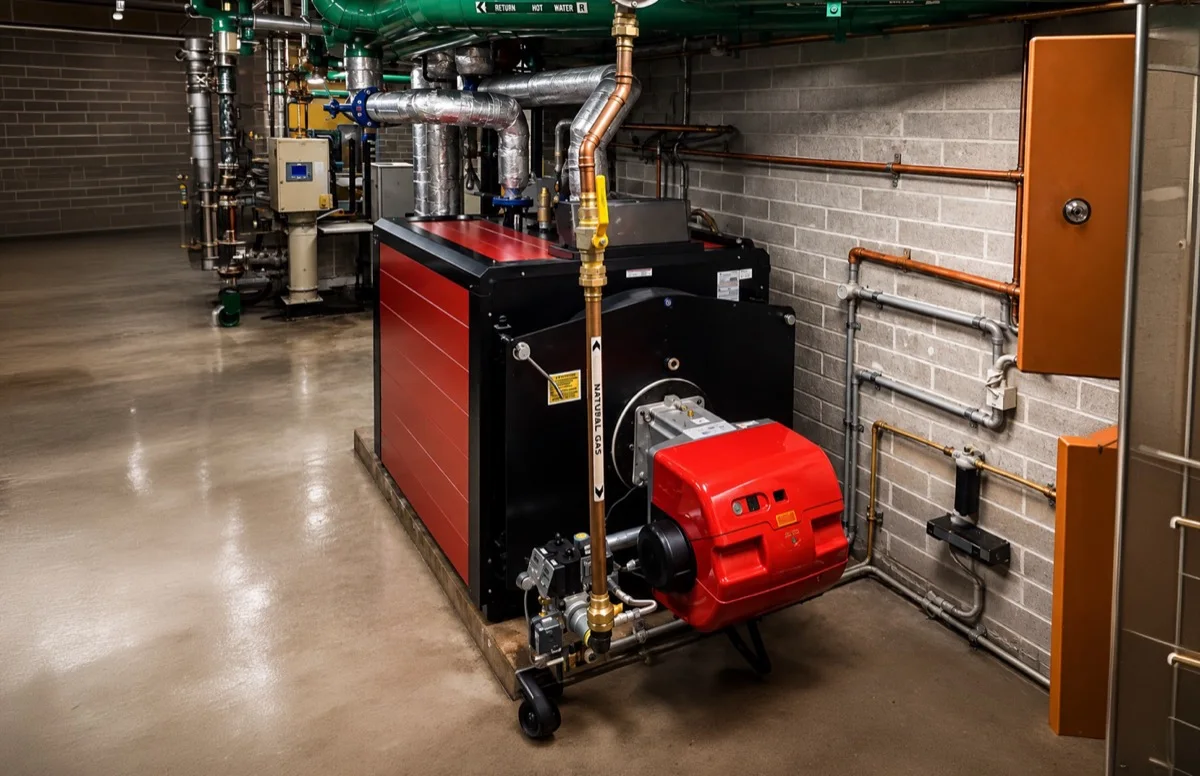
Efficiency and heat recovery: where each system leaks
Boiler efficiency and system efficiency are different questions, and the answer flips depending on which one is asked. A steam boiler and a hot water boiler of the same design generation show comparable combustion efficiency on a stack test, typically in the high 80% range before recovery equipment.
The difference appears outside the boiler, in distribution and recovery. Steam loses energy through the condensate and trap network. Hot water gains energy through flue gas condensation, provided return temperature stays low enough. Both effects are larger than the combustion efficiency gap between the two boiler types, which is why a comparison run on nameplate efficiency alone reaches the wrong answer.
Where steam systems lose efficiency
Four losses dominate on steam plant, and all four are recoverable.
Condensate return rate is the largest. Every kilogram of condensate not returned is a kilogram of hot, treated feedwater replaced with cold makeup, plus the treatment chemistry that goes with it. Live steam losses through failed open traps, leaking joints and unvented flash run continuously, 24 hours a day, and never announce themselves as a fault. Blowdown carries heat straight to drain unless conductivity control limits the rate and a recovery stage catches the remainder. Wet steam quietly degrades heat transfer at every load.
An economiser recovers stack heat into feedwater and improves overall boiler efficiency by up to 10%. Where the exhaust stream is hot enough to be worth capturing in its own right, a waste heat recovery boiler takes the same principle further.
Where hot water systems gain it
Hot water plant has one large lever that steam plant does not: return temperature.
Drop the return below the flue gas dew point, roughly 55°C on natural gas, and flue gas begins to condense inside the heat exchanger, recovering latent heat that a non condensing boiler sends up the stack. Condensing hot water boilers reach up to 98% efficiency on that mechanism. The O’Brien OBYCON range is built for it, with heat exchanger materials selected to survive acidic condensate, and it is cascade ready, so several units can be sequenced to hold the low return temperature the mechanism depends on across a wide load range. The casing carries Ecodense branding alongside the OBYCON code; both names refer to the same boiler.
The catch is hydraulic rather than thermal. A loop running a small temperature difference keeps returns hot, and the boiler never condenses regardless of the nameplate rating. Holding the design temperature difference is what turns a condensing specification into a condensing result. In practice: avoid overpumping, give control valves real authority, insulate the distribution and stop bypass leakage.
A saturated steam boiler cannot use this lever at all. Deaerator feedwater sits at 85°C to 105°C, above the flue gas dew point, so no cold surface exists to condense against. On steam plant the equivalent moves are economisers, blowdown heat recovery and condensate return discipline.
Cost, licensing and AS 2593 compliance in Australia
Capital and operating cost
Compare installed scope, not boiler price. Steam plant carries a deaerator or feedwater tank, feed pumps, water treatment, a blowdown vessel, pressure reducing stations, separators, the trap population and the full condensate return network. Hot water plant carries pumps and drives, expansion and pressurisation, air and dirt separation, more control valve scope and more heat exchanger surface at the loads.
Footprint is a real constraint on brownfield sites, and compact options exist on both sides. The Cleaver Brooks flexible watertube unit O’Brien supplies is designed to pass through a standard doorway, cuts floor space by 50% and weight by 40% against a comparable unit, and delivers steam up to 3 MW. O’Brien’s own answer to the same constraint is OBYVERT, a vertical three pass watertube unit with the boiler and burner engineered as a single package, which stands the heating surface up rather than spreading it across the plant room floor and still holds thermal efficiency above 92%.
On operating cost, steam is dominated by water treatment chemistry, makeup water, blowdown losses, trap maintenance and survey, plus the cost of whatever condensate never returns. Hot water is dominated by pumping power, heat exchanger fouling, glycol management where glycol is used, and the return temperature discipline that decides whether the condensing gain is real. Steam plant has more failure points to inspect, which is why boiler maintenance scope and response time weigh more heavily on the steam side.
Attendance, licensing and AS 2593
Compliance is the difference most comparison articles miss, and in Australia the difference carries real cost.
AS 2593 covers boiler safety management systems and the supervision requirements for unattended operation. The obligations fall unevenly between the two system types. A steam boiler above the relevant hazard threshold brings attendance and supervision duties, documented safety management, defined inspection intervals and, in most cases, a licensed operator holding the appropriate high risk work licence. A hot water boiler at moderate temperature and pressure usually sits outside that regime, while remaining pressure equipment with relief, temperature limiting and flow proving requirements of its own.
Translate the compliance requirement into deliverables at tender stage rather than at handover: traceable materials, pressure test records, relief device certification with documented set pressures, operating procedures, a maintenance plan, and a handover dossier matched to the site risk assessment and the statutory inspection regime.
Where a site chooses steam, operator competency stops being optional. O’Brien is a registered training organisation, RTO #45484, delivering boiler operation training that covers high risk work licence and unattended boiler units.
A selection checklist to run against your heat balance
Work through the checklist in order. The first three questions usually settle the industrial boiler specification.
- define the utility interface at the load. Direct contact, injection or sterilisation means steam. Indirect coil or heat exchanger duty only means hot water is in play.
- fix the required temperature at the load. Above 120°C at the process, steam is usually the practical answer. Below 95°C, hot water almost always wins. The 95°C to 120°C band is genuinely open and should be decided on control and compliance rather than on temperature.
- check the control requirement. Constant temperature condensing heat at a jacket suits steam. Ramp and soak profiles, multiple zones and low overshoot suit hydronic.
- assess the maintenance reality. Trap management, condensate return and periodic survey capability make steam viable. A lean team and long pipe runs push toward hot water.
- test the heat recovery case. Low grade waste heat and condensing potential integrate more simply on a water loop, while an existing high condensate return rate makes steam very competitive.
- size against measured demand profiles rather than connected load. Oversizing is the most common and most expensive specification error on both sides.
What O’Brien supplies on each side
O’Brien manufactures and supplies both industrial boiler types, which is why the recommendation is not predetermined by the product range.
On the steam side: monobloc units from 50 to 150 kg/h at 5 bar for light duty, OBYONE from 300 to 6,000 kg/h and OBYTRICE from 2,000 to 22,000 kg/h on the firetube side, OBYVERT where the plant room floor decides the layout, watertube D type plant with superheat to 565°C, Maxi watertube from 6 to 10 MW, John Thompson watertube from 10 to 18 MW, and reconditioned Cleaver Brooks stock. On the hot water side: OBYFLAME from 70 to 3,500 kW, and the OBYCON condensing range.
Electric covers both sides as a matched pair, for sites taking combustion out of the plant room. OBYPHASE is an instantaneous electric steam generator with net zero local emissions. OBYPHASE-W is the hot water counterpart, 180 to 540 kW at 5 bar design pressure, thermal efficiency above 99%, and classed for unattended operation under AS 2593-2021. Neither unit has a flue, a gas connection or a combustion side to inspect, which takes a measurable slice out of the compliance scope described earlier.
The engineering sits ahead of the equipment. Our engineering and consulting team runs the heat balance, the controls integration and the plant side scoping before a model is selected. For example, the Tabro Meat boiler upgrade, a 5,000 kW installation, followed exactly that sequence. Where a site needs interim capacity during a changeover, boiler rental covers the gap.
Not just installed. Engineered. Talk to our team about the right boiler for your process.
Frequently asked questions
What is the difference between a steam boiler and a hot water boiler?
The difference between steam and hot water boiler systems is the form the heat takes. A steam boiler boils feedwater and delivers latent heat of vaporisation, recovered as condensate at the load. A hot water boiler heats water without a phase change and delivers sensible heat through a closed circuit.
Three practical consequences follow. Steam temperature is fixed by pressure, so at 10 bar gauge steam arrives at 184°C whether the process wants 184°C or not, while hot water temperature is trimmed at a mixing valve. Steam carries roughly 24 times more energy per kilogram, so steam mains are small and hot water mains are large. And steam plant needs condensate return, trap stations and, above the relevant threshold in Australia, boiler attendance under AS 2593, where hot water plant needs pumps, expansion volume and heat exchanger surface instead.
How does an industrial hot water boiler work?
An industrial hot water boiler is a closed circuit system that heats water inside a pressure vessel and circulates it to coils, heat exchangers and process skids. Gas, oil or electric elements supply the heat. The water never boils. The loop is held above the saturation pressure of its hottest point, which is what allows supply temperatures above 100°C.
Heat transfers by temperature difference. First, water arrives hot at the load. Second, water gives up energy through a coil or exchanger surface. Third, water returns cooler for reheating. A typical industrial loop runs a 20 K difference between supply and return. Supporting equipment includes circulating pumps with variable speed drives, an expansion and pressurisation unit, relief valves, air and dirt separators, and control valves. Where return temperature falls below 55°C on natural gas, a condensing boiler such as the O’Brien OBYCON, branded Ecodense on the casing, recovers additional latent heat from the flue gas and can reach up to 98% efficiency.
What are industrial steam boilers used for?
Industrial steam boilers are used wherever a process needs the steam itself, or needs a fixed high temperature at the load. Three sectors account for most Australian demand.
- food and beverage. Cooking, retorting, tunnel pasteurising, humidification and clean in place duty all need steam, because steam can contact the product and because sterilisation needs temperatures above 120°C that saturated steam delivers naturally at 1 bar gauge and above. Second, chemical processing. Reactor jackets and distillation reboilers use condensing steam for a high heat transfer coefficient in a compact surface. Third, general manufacturing, covering drying, curing and cleaning duty. Steam also drives equipment directly, including ejectors and absorption chillers. One further advantage: a single steam plant can serve several unrelated users at different pressures through pressure reducing stations, which is harder to arrange on a hydronic loop.
Which is more efficient, a steam boiler or a hot water boiler?
At the boiler, both are comparable. A steam boiler and a hot water boiler of the same design generation show similar combustion efficiency on a stack test. Across the whole system, hot water usually wins, because a hot water loop can drop return temperature below the flue gas dew point of roughly 55°C on natural gas and condense the flue gas to reach up to 98% efficiency.
A saturated steam boiler cannot do that, because deaerator feedwater at 85°C to 105°C sits above the dew point. Steam systems also lose energy in ways hot water systems do not: failed open traps, unrecovered condensate, blowdown to drain, flash steam vented to atmosphere and standing losses on a hot main. Against that, steam delivers 24 times more energy per kilogram at the point of use, which cuts distribution size and pumping power. Judge on delivered energy per unit of fuel across the whole system.
Can a plant replace a steam boiler with a hot water boiler?
A like for like swap is rare, and the real cost sits downstream of the boiler. Converting steam to hot water means re-rating or replacing every heat exchanger, because a coil sized for condensing steam at 184°C will not deliver the same duty on water at 110°C. Control valves and instrumentation change. Traps, condensate receivers and return piping come out or get isolated.
Any load needing direct steam contact, sterilisation or humidification cannot convert at all and needs a small dedicated steam source. Converting in the opposite direction triggers new pressure class requirements, pressure reducing stations, drip legs, trap stations, condensate return hardware and, in Australia, the attendance and supervision obligations that steam plant carries under AS 2593. In both directions, re-run the heat and mass balance, confirm materials compatibility and re-validate relief sizing before committing capital.
Is it practical to run steam and hot water on the same site?
Running both is common and frequently the correct answer. The usual architecture is a steam plant sized for the duty that genuinely needs steam, plus a steam to water heat exchanger feeding a hydronic loop for building heat and low temperature process. Steam distribution stays short, which cuts trap count, standing losses and survey scope, while steam remains available where the process demands it.
The hybrid arrangement avoids a second combustion appliance, a second flue and a second gas connection. Resilience improves as well: the hydronic loop can carry critical heating while the steam plant is down for statutory inspection, and a rental unit covers the reverse case. The trade off is a temperature penalty at the exchanger, typically 5 K to 10 K of approach, which has to be allowed for when setting the hydronic supply temperature.
Does a steam boiler need a licensed operator in Australia?
In most cases above the relevant hazard threshold, yes. Australian workplace safety law requires a high risk work licence to operate boilers in defined classes. The licence classes are set nationally by Safe Work Australia and administered by the work health and safety regulator in each state. AS 2593 sets out the safety management systems and supervision requirements allowing a boiler to run unattended rather than with a permanent attendant.
The practical effect is a staffing and competency obligation on steam plant. A moderate temperature hot water plant usually carries no equivalent duty. Attendance is an operating cost, so price the obligation at selection stage, not at commissioning. O’Brien delivers the training as a registered training organisation, RTO #45484, covering high risk work licence and unattended boiler units. Confirm the applicable threshold and licence class with the regulator in your state before finalising a specification.
How do I size a boiler and avoid short cycling?
Sizing is done against measured demand, not connected load. First, collect a real demand profile, minute by minute where instrumentation allows. Second, size for the sustained load with a defined margin, not for the sum of every nameplate on site. Oversizing is the most common specification error. Oversizing causes short cycling, which wastes fuel on purge losses and shortens component life.
Modular plant is the standard fix on both sides. Several smaller boilers sequenced together give far wider turndown than one large unit. On steam, stabilise header pressure with correctly sized pressure reducing stations. Avoid oversized traps and control valves, which hunt. On hot water, use variable speed pumping, hold the design temperature difference and check control valve authority. A low temperature difference produces both short cycling and a boiler that never reaches its condensing efficiency.
Specify it once, correctly
The steam boiler vs hot water boiler decision is settled by the process, not by the price list. Latent heat service where the load needs contact, sterilisation or a fixed high temperature. Sensible heat service where the load needs controllable temperature and indirect transfer. Distribution, efficiency, compliance and lifecycle cost all follow from that first call.
O’Brien has completed more than 40,000 jobs across both system types in over 20 years, with around 350 years of combined experience in the team and 24/7 nationwide service behind every installation. Australia’s largest privately owned boiler company, with offices in Victoria, New South Wales, Queensland and Western Australia.
Request a quote or call 1300 771 759 to have an O’Brien engineer run the selection against your heat balance.